

Analysis UK Further Education 18.03.2026
What role should colleges play in tackling the NEET challenge?
The latest data from the Office for National Statistics, estimates that 957,000 young people aged 16–24 are NEET or not in education, employment or training, equivalent to one in eight people that age group. The majority, around 547,000, are classified as economically inactive.
Statistics alone cannot tell the whole story. But they do underline the scale of a challenge that cuts across education, employment, health and local economies.
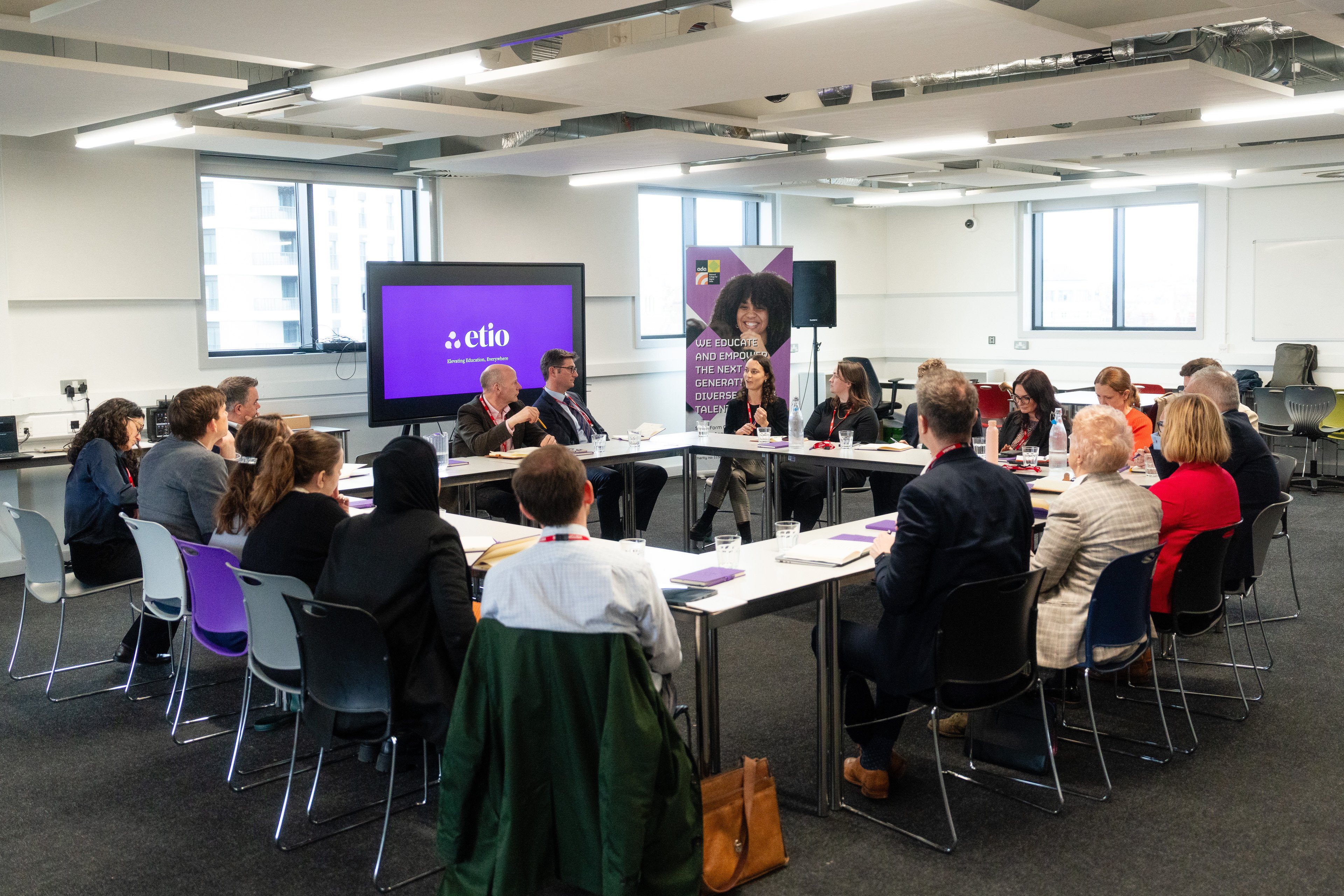
Recently at Etio we hosted a roundtable discussion on the role of further education in tackling the NEETs crisis. With around twenty leaders from across the further education sector, think tanks and charities to explore what more can be done, including Rise Up, King's Trust, the Centre for Social Justice, and Futures for all. The roundtable discussion was hosted at Ada, the National College for Digital Skills.
There were a wide range of perspectives, yet one theme quickly emerged: if we are serious about tackling the NEET challenge, further education colleges must be central to the solution.
Colleges already play a vital role, working in partnership with local organisations. They provide the practical, skills-focused education that helps people move into work, while also supporting adult learners to retrain and develop new skills. In many communities they are among the most trusted institutions, with deep links to employers and local services.
However, the wider system surrounding young people who are NEET remains fragmented. Responsibility is spread across government departments, local authorities, schools, charities, employment services and others. While each part of the system does valuable work, the discussion highlighted a lack of clear accountability for driving improvement across the whole system.
This raises an important question. Could colleges play a larger coordinating role locally, potentially even holding clearer responsibility for supporting those who fall out of education and employment? Any such approach would require careful alignment with local authorities, Jobcentres and other services. However, participants pointed out that colleges already sit at the intersection of education, employers and local communities and so were well place to take on this convening role.

Participants also stressed that there is no single NEET cohort. The causes and barriers vary widely. Young people aged 16–18 may still be closely connected to schools and community groups. Meanwhile one of the fastest growing groups includes graduates aged 21–24 who are struggling to find stable employment. Effective responses therefore need to be tailored, with a clearer taxonomy of the different groups involved.
Practical support also matters. Many young people need help that goes beyond qualifications alone. Work experience, support with CV writing and interviews, access to industry specific accreditations and strong functional skills in English and maths all play an important role. Mental health support has also become increasingly important, with the post-pandemic rise in anxiety and sickness absence creating new barriers to employment for some young people.

Colleges across the country are already responding with innovative approaches and several other organisations and charities are also delivering innovative practices that colleges could learn from. Short employability courses delivered with employers and local or combined authorities are helping young people build confidence, develop soft skills and gain the credentials needed to enter the workplace. Yet scaling these initiatives remains a challenge. Alongside this, at Etio we know from our work with colleges across the country that now, more than ever, there are financial and capacity pressures that colleges are faced with, along with taking on any further responsibility.
Policy developments such as the government’s Youth Guarantee and the broader Get Britain Working agenda create an opportunity to rethink how the system works. At the same time, Local Skills Improvement Plans and the growing role of mayoral combined authorities offer a framework for stronger local coordination.

What our roundtable reinforced is that progress will depend on collaboration rather than any single institution acting alone. Colleges, local authorities, employers, health services and charities all have a part to play.
But if we want a system that helps more young people move successfully into work and learning, we should start by asking a simple question. Given their reach, expertise and local relationships, should colleges play a more central role in bringing that system together?
It is a question worth exploring further.